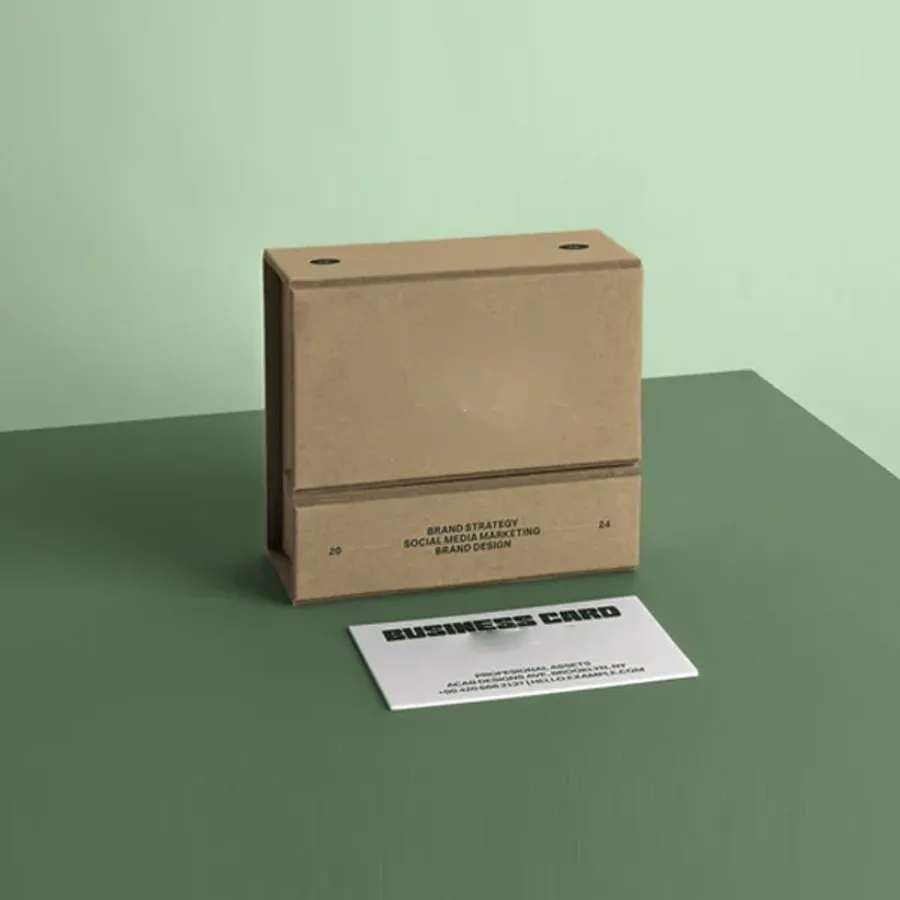
Who mails business cards in a dedicated box
Most of these boxes go to print shops and online card printers. They need a neat, protective way to send finished card orders to their own clients.
Agencies and office managers order them too. A new hire, a sales team or a branch office often needs several names posted at once, sorted and labeled.
Freelancers rarely need them. The volume only makes sense once you post cards every week, or send many names in one go.
Event teams, real estate offices and consultants with many staff also use them. In each case the box does one job: keep a block of thin cards flat, square and clean until someone opens it.
Working out box depth from your stack
Depth is the measurement people get wrong most often. Card stock varies, so two orders of the same count can need different boxes.
The simplest fix is to measure a real stack rather than guess from paper weight. Send us the result and we set the depth.
Do this for each card stock you sell. A soft cotton stock and a smooth coated stock of the same count rarely stack to the same height.
- Take 100 of your finished cards, or the closest stock you have.
- Squeeze the stack lightly and measure its height with a ruler.
- Multiply by the number of hundreds you plan to put in each box.
- Add a little room if the cards have raised foil or thick edges.
- Send the total depth, card size and count with your quote request.
Corrugated mailer or paperboard keepsake
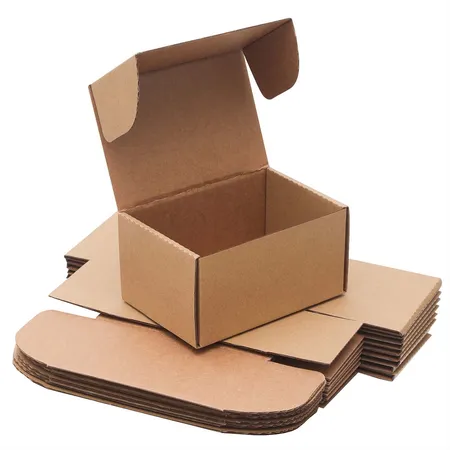
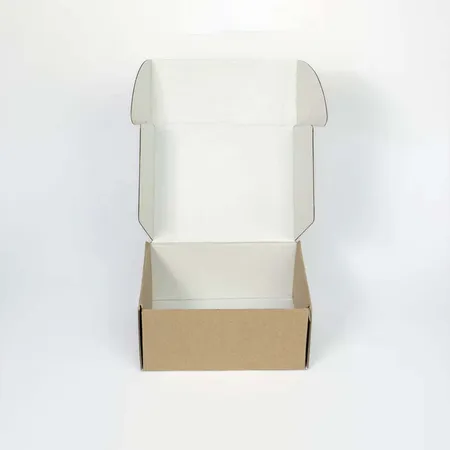
For cards going straight into the post, E-flute corrugated is the safer choice. Its fluted middle layer absorbs knocks that would dent a thin carton.
Paperboard at 18 to 24 pt suits a different job. It works as an inner presentation box that a client keeps on the desk, often placed inside a larger shipper.
Weight matters here too. A full box of cards is dense, and thin paperboard can bow at the base when someone lifts it by one end.
Some print shops use both. A slim printed paperboard box holds each name, and a corrugated outer carries the whole batch. Our comparison of corrugated and paperboard board types lays out the trade-offs.
Dividers for several names in one shipment
When one parcel holds cards for five people, the recipient should not have to sort them. Dividers split the box into lanes, one stack per name.
We cut dividers from paperboard or thin corrugated and size each lane to the stack height. A printed tab or a small label area on each divider makes the names easy to read.
Some jobs need a fitted tray instead of dividers. Our page on mailer boxes with fitted inserts shows the insert styles we make for small items.
Protecting card corners and edges
Cards fail in transit in a few predictable ways. The fixes are simple and mostly built into the box design.
- A snug fit on all four sides, so the stack cannot slide and hit the wall
- Corrugated board rather than thin card for anything posted on its own
- A wrap band or paper sleeve around each stack before it goes in
- No loose filler pressing into the face of the top card
- A closure that stays shut under the weight of the cards
- Gloss or matte lamination on the box only if it will be handled a lot
Card stocks that need extra room or care
Not every card is a thin coated rectangle. Specialty stocks change how the box should be built, so mention them early.
Thick cotton and letterpress cards are soft at the edges and dent easily. They need a tight fit and no filler pressing on the face. Painted edges can rub color onto the box wall, so a paper wrap around each stack helps.
Rounded corners leave small gaps at each end of the box. That is normal and causes no harm when the stack is snug side to side. Cards with die-cut shapes, such as circles or leaves, usually need a custom tray rather than a plain rectangle.
Printing a box for a print shop
A print shop's own packaging gets judged harder than anyone else's. Clients expect the box to show the same care as the cards inside.
Kraft with white ink is a popular look for small studios. It reads as hand-made and keeps the box simple. White board with full color suits printers who want to show off color range on the lid.
Keep contact details off the outside if the box goes to a client's client. Many trade printers send unbranded boxes for that reason and add their logo only inside.
The inside lid is a good place for reorder details or a short note on caring for specialty stocks. Shops that also post notebooks or letterpress items often pair this box with our stationery shipping box range.
Self seal closures for posting from the counter
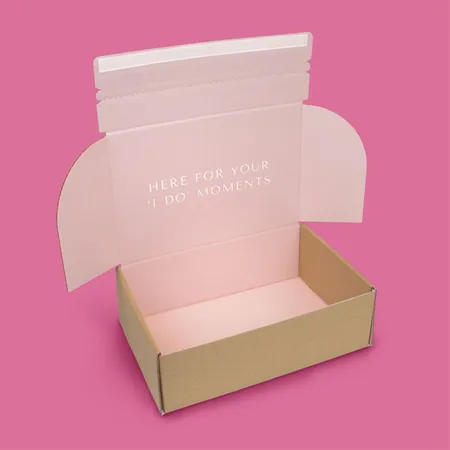
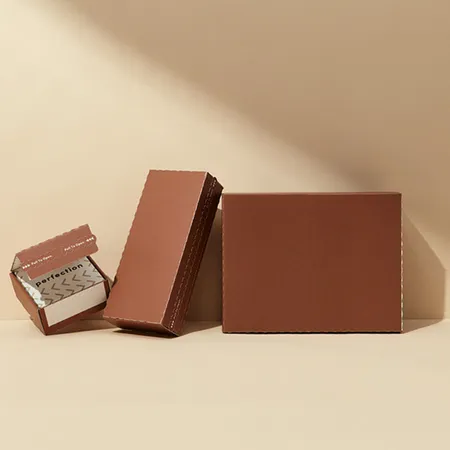
Busy counters do not have time for tape guns. A peel-and-seal strip lets staff close the box in one move.
A tear strip can be added so the client opens it cleanly without a knife near the cards. Both work well on small E-flute boxes.
Peel strips are single use. If the client will reopen the box to take cards out over months, a tuck closure ages better.
Tuck top and roll end tuck front closures suit boxes that will be opened and closed many times on a desk. Details on the peel strip style are on our self seal mailing boxes page.
Timing boxes against your card orders
Boxes take 4 to 6 business days to produce after you approve the proof. Transit takes another 2 to 3 business days.
Card printers usually turn jobs faster than that, so order boxes ahead and keep a stock on hand. The boxes ship flat and store easily on a shelf.
We cover delivery to the US, UK, Canada and Australia at no charge. Delivery details for each region are on our box shipping policy page.