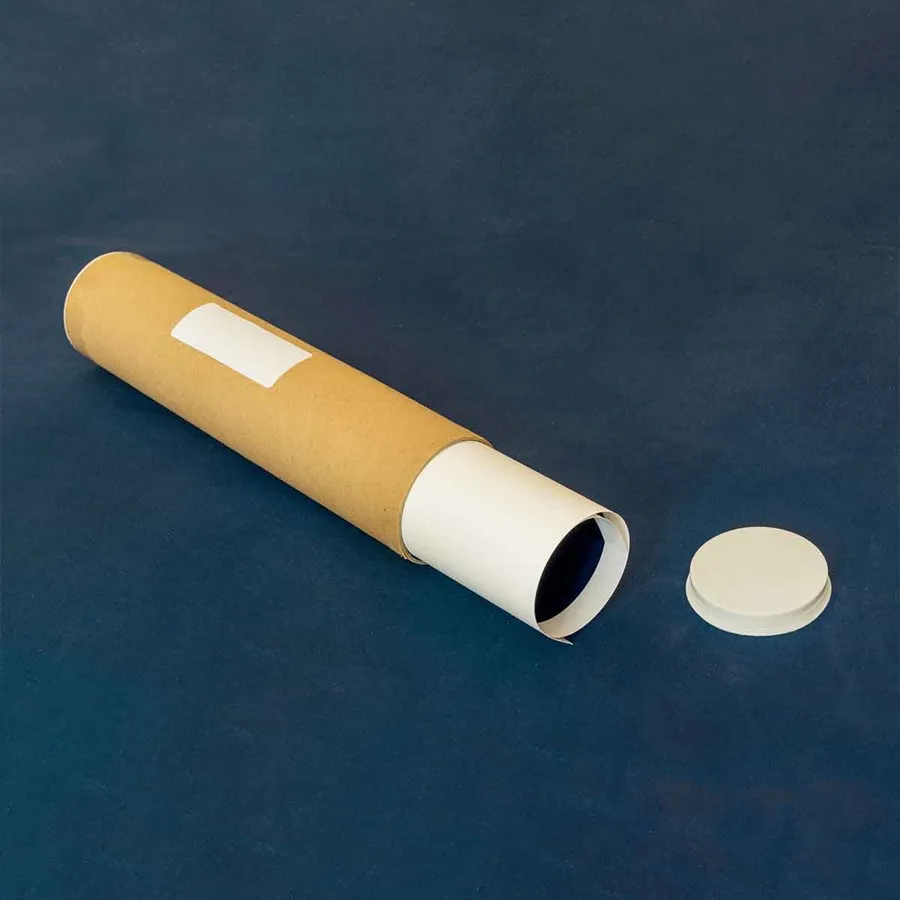
Products that travel best in a tube
Some products simply do not want to be folded or squared off. A tube carries them in their natural shape.
Illustrators and print shops use cylinders for posters, maps and drawings. Tea and coffee sellers use smaller tubes for loose leaf and ground blends packed in an inner bag.
Apparel brands roll socks, scarves and t-shirts into tubes. The result feels like a gift and stands out on a shelf. Candle makers and bath brands pick the round shape because it suits a jar or bar.
Brands also use tubes for limited runs and launch kits. A round pack gets noticed on a desk or shelf. Almost everything around it is square.
- Art prints, posters and rolled canvas
- Maps, diplomas and plans
- Loose leaf tea and coffee in an inner pouch
- Rolled socks, scarves and tees
- Candles, bath bombs and soap bars
- Gift sets and launch kits
How a paper tube is put together
The wall is rigid chipboard formed into a cylinder. A printed paper wrap goes around the outside, and a liner paper covers the inside.
The base is closed with a fitted cap. The lid slides over the top and holds by friction, so there is no tape on the printed surface.
Because the wall is rigid, a tube resists crushing from the side better than a thin folding carton. It still needs a snug fit inside so the product does not slide end to end.
The caps are made from the same board as the wall. That keeps the ends as stiff as the sides, which matters when tubes are stacked upright in a shipping bin.
Designing artwork for a curved wrap
Tube artwork is a long flat rectangle that wraps all the way around. Where the two ends meet there is a seam. Your design should be quietest there.
Keep your logo and main text away from the seam line. A front panel facing the customer, with ingredients or a story on the back, reads naturally on a round shape.
The lid and base get their own artwork. Building the files yourself? Our step by step box artwork guide explains bleed and safe zones.
Tube parts and what each one prints
Each part of a cylinder takes artwork separately. The table shows what buyers usually put where.
Small text on the lid rim is hard to read once it curves. Save the rim for a simple color band or a repeating pattern.
Your proof shows every part laid flat, side by side. Check the lid and body together so the colors and logo position match when the tube is closed.
| Part | Common artwork | Tip |
|---|---|---|
| Body wrap | Logo, product name, pattern | Keep text off the seam |
| Lid top | Logo or icon | Center it, the circle crops corners |
| Lid rim | Color band or pattern | Skip fine text |
| Base | Barcode, care notes | Flat area prints cleanly |
| Inside liner | Solid color or message | Seen when the lid comes off |
Finishes that suit a round surface
A matte lamination gives a calm paper feel that fits tea, stationery and art brands. Soft-touch feels smooth in the hand, which matters because people hold a tube rather than set it down.
Foil stamping on the lid top catches light as the tube turns. Spot UV works well on a single logo but loses impact if spread around the whole wrap.
Lamination also protects the wrap from scuffs. A round tube rolls against other parcels in transit, so an unprotected wrap can show rub marks.
You can see close-up photos of each effect in our guide to box printing and finishes. Pick one accent for the lid and keep the wrap simple.
Holding the product still inside
A tube that is slightly too long lets the product slide and knock the caps. That is the most common complaint we hear about round packaging.
A paperboard collar or holder fixes this. It sits around a jar or bottle and keeps it centered so the wall takes the knocks.
For rolled paper, a slightly smaller diameter keeps the roll from unrolling against the wall. For candles in glass, look at our candle shipping boxes built for glass jars if you need square corners and more padding.
Mailing a cylinder safely
A tube rolls, so carriers handle it slightly differently from a flat box. Many sellers ship a tube on its own with a label wrapped around the body.
For fragile contents or long distances, put the tube inside a plain outer carton. The printed tube then arrives clean for the unboxing.
A strip of tape over the base joint stops the cap working loose on a long trip. Keep tape off the lid so it does not lift the printed paper when peeled.
If a tube arrives crushed, photograph it before you open it. Our reprint and refund policy for damage covers transit damage reported within 10 days.
Mistakes we catch on tube proofs
Most tube problems show up on the flat proof if you know where to look. Here is what we point out on tube proofs.
None of them cost anything to fix at proof stage. They are much harder to fix once a run of tubes is formed and wrapped.
- A logo split in half by the wrap seam
- Lid artwork that does not line up with the body
- Text placed where the lid overlaps the body
- A diameter sized to the product with no room for tissue
- Barcodes printed on the curve, where scanners struggle
Tube or folded box for your product
A cylinder takes more effort to fill and stack than a folded mailer. It arrives assembled, so it needs more storage space than flat boxes.
The payoff is shelf presence and a gift feel. If you want a firm premium carton with square corners, compare our rigid packaging mailers with wrapped board before you decide.
For prints that must stay perfectly flat, a folded carton may suit better than any tube. Unrolled paper needs a flat box with stiff panels on both sides.
From quote to delivered tubes
Send your product size, how many tubes you need and any artwork. Tubes are priced from $0.30 per unit, with diameter, length, material, quantity and finish shaping the quote.
We return a free digital proof showing the flat wrap, lid and base, with unlimited revisions. You can request a tube quote online whenever your sizes are ready.
Once you sign off the tube proof, forming and printing take 4–6 business days. Finished tubes then travel for 2–3 business days, with delivery covered to the US, UK, Canada and Australia.